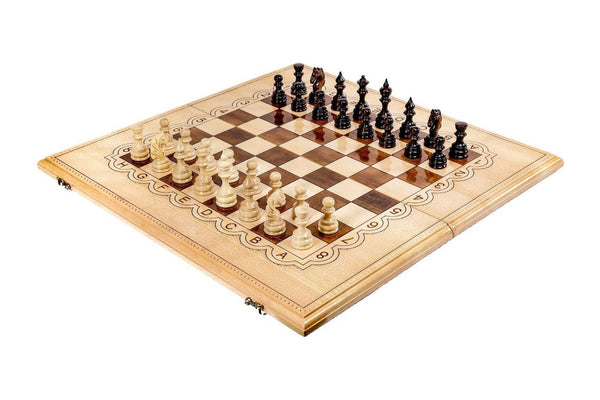
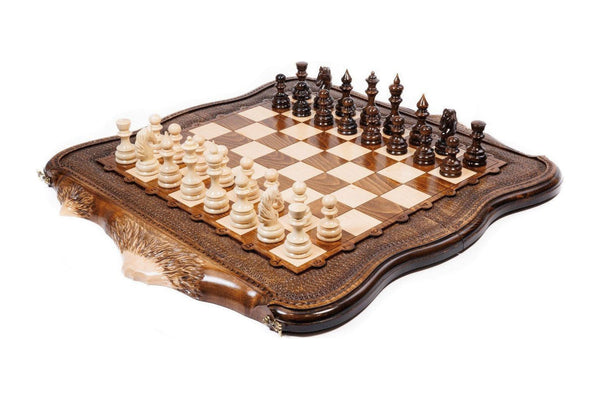
In short: Armenian symbols carry layered meanings: the eternity sign (arevakhach) traditionally stands for everlasting life, the pomegranate for life and abundance, Mount Ararat for national identity, the alphabet for language, and the eagle and coat of arms for statehood. We carve these symbols into our boards, so a set can say something about the person who receives it.
This guide to Armenian symbols and their meanings explains what each one is, where it appears in Armenian culture and how it shows up in our designs. A table near the end pairs each symbol with an occasion, which helps if you are choosing a gift. Some meanings come from church tradition and others from folk custom, so we point out the readings that are interpretations.
What does the Armenian eternity sign (arevakhach) mean?
The Armenian eternity sign is a wheel of curved arms that seems to spin around a central point, and in medieval Armenian culture it stood for everlasting, heavenly life. Its Armenian name, arevakhach, is usually translated as "sun cross". The number of arms varies from one example to the next.
It is one of the most common motifs in Armenian architecture, carved on church walls, gravestones and khachkars, and it also appears in illuminated manuscripts and carpets. On a game board it speaks of continuity, which suits a set meant to be handed down. You will find it on our Eternity Sign backgammon set.

What is a khachkar?
A khachkar is an upright stone slab carved with a cross; the word joins khach, "cross", and kar, "stone". Medieval Armenians raised them as memorials and to mark important events. UNESCO inscribed the art of the khachkar on its Representative List of the Intangible Cultural Heritage of Humanity in 2010, and tens of thousands survive in Armenia, no two alike.
The cross usually rises from a sun disc or eternity wheel, and the rest of the stone is often filled with plant motifs, such as leaves, grapes and pomegranates, and with bands of interlace. Similar ornament decorates Armenian manuscripts and carpets. The braided bands on the borders of many of our boards echo it.
The pomegranate and the grapevine in Armenian culture
In Armenian tradition the pomegranate is a national symbol of life, abundance and prosperity, and it is also linked with fertility. A newer custom has the Armenian Church bless pomegranates at New Year, after which families often break open the fruit, its many seeds standing for the blessings hoped for in the year ahead.
The fruit has a long history in Armenian art. Carved pomegranates and grapevines decorated the seventh-century cathedral of Zvartnots, and Sergei Parajanov's 1969 film The Color of Pomegranates, a poetic portrait of the 18th-century troubadour Sayat-Nova, includes the image of pomegranate juice bleeding into white cloth.
The vine goes back a very long way in Armenia. In the Areni-1 cave near the village of Areni, archaeologists found a wine press and a fermentation vat dated to roughly 4100–4000 BC, which they describe as the oldest known winery. Our pomegranate and grapes backgammon set puts both fruits on one board, together with our Mount Ararat outline.

Mount Ararat (Masis) as a national symbol
Mount Ararat, called Masis in Armenian, stands in present-day Turkey, yet it can be seen from Yerevan on a clear day and is widely regarded as Armenia's principal national symbol. It sits at the centre of Armenia's coat of arms, with Noah's Ark resting on it.
Our copyrighted outline of the mountain has been part of our products since 2000. On models with the outline, the opened board shows Mount Ararat from two sides: from Armenia and from Turkey. The full story is in Mount Ararat in Our Designs.
The Armenian alphabet
Mesrop Mashtots created the Armenian alphabet around 405 AD. It began with 36 letters, and two more were added in the Middle Ages, giving the 38 letters of the classical alphabet. The letters also served as numbers, and decorating them became a craft of its own: UNESCO recognised Armenian letter art, practised by calligraphers, carpet weavers, embroiderers and jewellers, in 2019.
That tradition of ornamenting letters is one reason the script makes such a natural decoration. You will find Armenian letters on our alphabet boards and on our alphabet wall clocks.
Armenian carpets and ornaments
In Armenian homes a carpet was far more than a floor covering. Rugs were woven as dowry pieces, gifts and commemorative pieces, and their ornament carried meaning: the wheel of eternity is one motif, and crosses joined the repertoire once Armenia adopted Christianity.
The Lori-Pambak region of northern Armenia gave its name to a recognised carpet type, typically built around a central medallion with a cross-like form. Our Lori carpet backgammon table takes its ornament from Armenian carpets, and the cross-stone pattern is one of its features.

The Armenian eagle, the coat of arms and Etchmiadzin Cathedral
Armenia's coat of arms, adopted in 1992, shows a shield with Mount Ararat and Noah's Ark at its centre and the emblems of four historic royal dynasties around it, held up by an eagle and a lion. The eagle is linked with the older Artaxiad and Arsacid dynasties and the lion with the later Bagratuni and Rubenid ones. Eagles also appear in medieval stone: the pier capitals of Zvartnots were carved with them.
Etchmiadzin Cathedral, the mother church of the Armenian Apostolic Church, is traditionally dated to AD 301–303, and UNESCO placed it on the World Heritage List in 2000. Our Etchmiadzin and Coat of Arms two-sided backgammon set brings the cathedral and the arms together.

How to choose a design by meaning
Pick the symbol that says what you want to say. The table pairs each one with a common reading and an occasion; the readings are interpretations, and families often have their own. Our gift guide for backgammon players has more ideas, and boards in our personalised backgammon sets can carry an engraved name, date or short wish of up to 80 characters inside.
| Symbol | Often read as | Good for |
|---|---|---|
| Eternity sign | Everlasting life, continuity | Weddings, anniversaries, heirlooms |
| Pomegranate | Life, abundance, fertility | New homes, newlyweds, New Year |
| Grapes and vine | Plenty, an ancient winemaking land | Hosts and wine lovers |
| Mount Ararat | National identity, home | Armenians living abroad, new homes |
| Alphabet | Language and learning | Graduations, teachers |
| Eagle and coat of arms | Statehood, royal heritage | Milestone birthdays, retirements |
| Carpet pattern | Home and family craft | First homes, wedding gifts |
Frequently asked questions
What does the Armenian eternity sign mean?
The Armenian eternity sign, or arevakhach ("sun cross"), is a wheel of curved arms that stands for eternity and everlasting, heavenly life. It has been carved on Armenian churches, gravestones and khachkars, and painted in manuscripts, since medieval times. As a symbol of continuity, it is a natural choice for wedding, anniversary and heirloom gifts.
What does the pomegranate symbolise in Armenian culture?
In Armenian tradition the pomegranate is a national symbol of life, abundance and prosperity, and it is also linked with fertility. Its many seeds are often read as blessings, and the fruit is widely used in church architecture, art and manuscript miniatures.
Who created the Armenian alphabet, and how many letters does it have?
Mesrop Mashtots created the Armenian alphabet around 405 AD. It began with 36 letters, and two more were added in the Middle Ages, giving the 38 letters of the classical alphabet. The letters are still used for writing Armenian and as decoration, a tradition UNESCO recognised in 2019.
Which Armenian symbol makes the best gift?
It depends on who receives it. The eternity sign suits weddings and anniversaries, the pomegranate suits a new home or New Year, Mount Ararat suits Armenians living abroad, and the alphabet suits anyone who loves language. Boards in our personalised collections can carry a name, date or short wish of up to 80 characters inside.
Explore Armenian designs
Browse our Armenian backgammon sets, Armenian gifts and chess sets to find the symbol that suits you, or learn more about the workshop in our story. Our boards are handcrafted in beech or walnut.