In short: Mount Ararat, called Masis in Armenian, is widely seen as the national symbol of Armenia: a snow-capped, twin-peaked volcanic massif, 5,137 metres high, that stands at the centre of the country's coat of arms and, by tradition, is where Noah's Ark came to rest. Its outline has been the signature of our boards since 2000.
For Armenians, few images carry as much meaning as this mountain. This guide covers what Mount Ararat is, why Armenians hold it so dear, how Noah's Ark became part of its story, and how its outline became the mark of the chess and backgammon sets from our workshop.
How high is Mount Ararat, and what are its two peaks?
Mount Ararat is a volcanic massif in the far east of present-day Turkey, close to the borders with Armenia and Iran. It has two cones: Greater Ararat, the highest mountain in Turkey, and the smaller Lesser Ararat beside it. In Turkish the massif as a whole is Ağrı Dağı, and each peak has its own name in Armenian and Turkish.
| Peak | Armenian name | Turkish name | Height |
|---|---|---|---|
| Greater Ararat | Masis (Մասիս) | Büyük Ağrı Dağı | 5,137 m |
| Lesser Ararat | Sis (Սիս), also Little Masis | Küçük Ağrı Dağı | 3,896 m |
Some reference works give slightly different figures for the two peaks, such as 5,165 and 3,925 metres, so you may come across both sets of numbers. The first recorded modern ascent of Greater Ararat took place on 9 October 1829 (27 September in the old-style Julian calendar). It is credited to the Baltic German professor Friedrich Parrot, who climbed with the Armenian writer and educator Khachatur Abovian as his guide and interpreter.
Why is Mount Ararat a symbol of Armenia?
It is the great landmark of the Armenian Highlands and, for many Armenians, a sacred mountain. The massif rises more than three and a half kilometres above the Ararat plain, and on clear days it can be seen from Yerevan, about 54 kilometres away. It is widely considered Armenia's principal national symbol, even though it stands across the border, in present-day Turkey.
Armenian tradition also ties the mountain to the nation's beginnings. The early historian Movses Khorenatsi traces the Armenians to Hayk, a descendant of Noah, and links the mountain's name to Hayk's own family.
The modern republic says the same thing in heraldry. Armenia's coat of arms, adopted on 19 April 1992 and based on the emblem of the First Republic of 1918–1920, places Mount Ararat with Noah's Ark at the centre of its shield. The shield also carries the emblems of four historic Armenian dynasties and is held up by an eagle and a lion.
Mount Ararat and Noah's Ark: what Genesis says
Tradition holds that Noah's Ark came to rest on Mount Ararat after the Flood, and the Persian name of the mountain, Kuh-e Nuh, means “the mountain of Noah”. The Bible itself is more careful: Genesis 8:4 says the ark rested “upon the mountains of Ararat”, without naming a single peak.
In Genesis, Ararat is the Hebrew form of Urartu, an Iron Age kingdom centred on Lake Van that emerged in the 9th century BC, so the phrase most likely describes a mountainous region rather than one summit. The Latin Vulgate even renders it as “mountains of Armenia”. Over time, tradition settled on the great cone of Masis, and the coat of arms reflects that tradition.
This story of survival and new beginnings has inspired boards such as our walnut backgammon set with a Noah's Ark scene and the Ararat outline.

How did the Ararat outline become our signature?
Master Hrachya Ohanyan began his work in 1985. Since 2000 the copyrighted Mount Ararat outline, created by him, has appeared in our products, and over the years the contour of Masis has become the hallmark of the workshop. You can read more about the craft in our story.
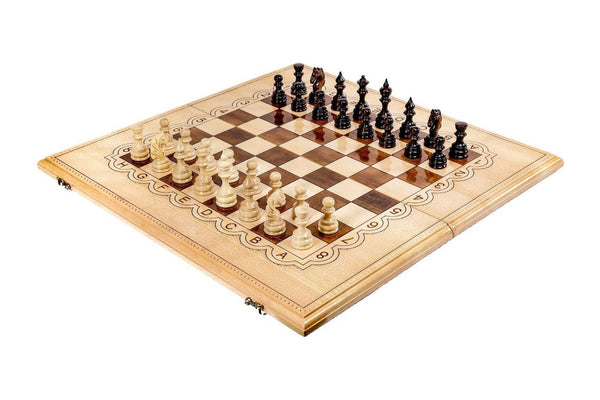
On models that carry the outline, the opened board shows Mount Ararat from two sides: as it is seen from Armenia and as it is seen from Turkey. One mountain, two points of view. The Mount Ararat Chess Set, 50 cm is one example.

Which sets carry the Ararat outline?
The outline appears on many of our chess, backgammon and 2-in-1 sets, often beside other symbols of Armenian heritage such as the eternity sign, the pomegranate, the eagle, Etchmiadzin Cathedral or the coat of arms.
- Mount Ararat backgammon sets: nardi boards with 32 checkers and dice.
- Mount Ararat chess sets: boards with 32 chess pieces.
- Mount Ararat chess and backgammon sets: chess on one side, backgammon on the other, folding on cast bronze hinges and locks.
Some designs pair the mountain with another emblem, such as the Eagle Backgammon Set with Mount Ararat, 60 cm.

The outline also appears on gifts, such as a wooden duduk case for the duduk, the traditional Armenian wind instrument.
A gift with meaning
For many Armenians living abroad, a board carrying the outline of Masis is more than a game: it is a piece of home. That is why Ararat designs suit weddings, anniversaries and new homes. On our personalised collections we add free engraving of a name, a date or a short wish of up to 80 characters inside the board, and our products come with a 25-year guarantee certificate. For more ideas, see our gifts for backgammon players.
Frequently asked questions
How high is Mount Ararat?
Greater Ararat, called Masis in Armenian, is 5,137 metres (about 16,850 feet) high, which makes it the highest mountain in Turkey. Lesser Ararat, or Sis, reaches 3,896 metres. Some reference works give 5,165 and 3,925 metres instead, so you may see slightly different figures.
Why is Mount Ararat a symbol of Armenia?
It is the great landmark of the Armenian Highlands, tied by tradition to Noah's Ark and to the story of the nation's beginnings, and it stands at the centre of Armenia's coat of arms. Although the mountain lies in present-day Turkey, it remains a central symbol of Armenian identity and can be seen from Armenia.
What does Masis mean?
Masis is the Armenian name of Greater Ararat; Lesser Ararat is Sis, or Little Masis. A traditional explanation, recorded by the historian Movses Khorenatsi, says the mountain was named after Amasia, a great-grandson of the legendary patriarch Hayk. Scholars have proposed other origins, including a Middle Persian word meaning “the largest”, so the exact meaning is still debated.
Is Mount Ararat visible from Yerevan?
Yes, on clear days. The mountain, with both of its cones, can be seen from many parts of Yerevan, including the centre, but haze and cloud often hide it. For a closer view across the Ararat plain, many visitors go to Khor Virap monastery, south of the capital, which lies within sight of the mountain.
Which sets feature the Ararat outline?
Our copyrighted Mount Ararat outline appears on many of our chess sets, backgammon sets and 2-in-1 chess and backgammon sets, and on gifts such as a wooden duduk case. On models with the outline, the opened board shows the mountain from two sides, from Armenia and from Turkey.
Explore designs inspired by Masis
If the mountain speaks to you, browse our Armenian backgammon sets (nardi) or our wider range of Armenian gifts. Our boards are handcrafted from beech and walnut, and many of them carry the outline of Masis.