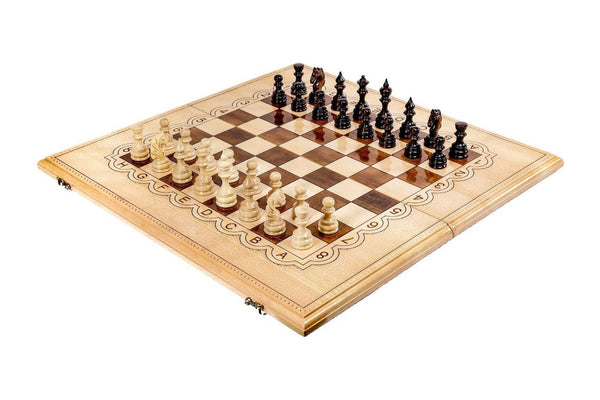
In short: choose walnut for a dark, warm, stable board with a formal look, and beech for a paler wood that is generally harder and keeps fine carved lines crisp. Both are hardwoods with a long record in furniture, and both suit everyday play.
Walnut and beech are the two woods we carve in our workshop, and they give a board very different personalities. Here are published figures for both, then how each carves, ages and suits a room, a player or a gift.
Walnut wood: warm brown, carves well, dimensionally stable
Walnut heartwood runs from light brown to deep chocolate, sometimes with grey, purple or reddish undertones, so no two boards look quite alike. The grain is usually straight but can turn wavy or curly, and the texture is medium. Woodworkers describe walnut as easy to work with hand and machine tools when the grain is regular, and it is a favourite for fine furniture, gunstocks and carving. Once dry, it also moves relatively little when humidity changes, which suits a board that is opened, closed and carried.
Beech wood: pale, dense and fine-grained
Beech is a pale cream to light pinkish-brown wood with a straight grain and a fine, even texture. It is dense and hard, takes glue and finishes well, and is a traditional timber for furniture, chairs and flooring. Its weak points matter outdoors more than on a table: beech has little natural resistance to decay or insects, so keep any beech piece indoors and dry.
Walnut vs beech wood: a side-by-side comparison
| Property | Walnut | Beech |
|---|---|---|
| Colour | Light brown to deep chocolate | Pale cream to light pinkish-brown |
| Grain and texture | Usually straight; medium texture | Straight; fine, even texture |
| Janka hardness (lbf) | About 1,000 to 1,200 | About 1,300 to 1,450 |
| Density, air-dried (about 12% moisture) | About 610 to 680 kg/m³ | About 700 to 750 kg/m³ |
| Shrinkage on drying (tangential) | About 7.5 to 8% | About 12% |
| Movement with humidity | Relatively low once dry | Higher |
| Carving | Carves well; figured grain can tear | Firm; crisp, precise detail |
| Colour in light | Tends to lighten toward golden brown | Tends to darken toward warm, reddish tones |
| Often chosen for | Heirloom sets, formal rooms, special gifts | Everyday play, fine ornament, bright rooms |
Figures are published averages for English or common walnut (Juglans regia), American black walnut (Juglans nigra) and European beech (Fagus sylvatica). The lower Janka figure for beech is the rating for American beech, and some sources list European beech at about the same. Sources differ by several per cent and individual trees differ more, so read the figures as a guide, not a specification. Shrinkage is tangential, green to oven-dry. A finished board’s weight depends mainly on its size and construction, so the density figures say little about the weight of a particular set.
Which is harder, walnut or beech? Janka figures compared
On published figures, beech is harder. The Janka test records the force needed to push an 11.28 mm steel ball halfway into the wood, so it expresses resistance to denting and wear in pounds-force (lbf). Published averages are about 1,010 lbf for American black walnut and about 1,200 for English walnut, against about 1,300 for American beech and 1,300 to 1,450 for European beech, depending on the source. Eastern white pine, a softwood, is roughly 380 lbf. Depending on which species and sources you compare, beech leads walnut by anything from under 10 per cent to over 40 per cent, and several European data sheets that use other hardness scales also rate beech as the harder wood.
“Hardwood” is a botanical term for broadleaved trees, not a promise of hardness; some hardwoods, such as basswood and balsa, are softer than most softwoods. On a game board, beech offers somewhat more margin against dents from dice and checkers, while walnut is hard enough to be a standard wood for furniture and gunstocks.
Which wood carves finer detail?
Both hold detail well but behave differently under the tool. Walnut tends to be the easier of the two to carve by hand when its grain is straight and regular, although wavy or figured pieces can tear and very small elements can chip. Beech is firmer and asks for more effort, yet its fine, even texture takes a clean edge, which suits intricate patterns. To many eyes, walnut’s tone and grain add depth to bold ornament, while pale beech lets fine lines read crisply. For a carved design, see our Octagram & Scorpion Backgammon Classic (60 cm).

How do walnut and beech age?
Light tends to change the two woods in opposite directions. Walnut in a bright room tends to lighten slowly toward a more golden brown, and woodworking sources describe it mellowing to a lighter brown with age; in a 2021 laboratory study of four woods, black walnut was the most sensitive to yellowing and bleaching by visible light. Beech tends to deepen and warm: in a 2025 study of European beech, untreated wood darkened and turned redder and yellower after 35 days behind a west-facing, double-glazed window, although the darker, redder “false heartwood” core that some trees develop did not follow the same pattern. A clear finish with UV-filtering additives slows these shifts but cannot stop them.
Humidity and finish matter too. Beech’s higher shrinkage means it tends to respond more to swings in humidity, so steady room conditions suit both woods. Our boards are varnished, and a clear finish usually deepens and warms the colour of wood; some varnishes continue to turn amber as they age. Our care guide for wooden chess and backgammon sets explains how to protect a board from sun, heat and damp.
Two woods together, and with epoxy resin
The two woods also work together: the 32 backgammon checkers in our sets are made of beech and walnut, so a pale wood and a dark wood sit side by side on the board.
Resin changes how each wood reads. Where an engraved design is filled with coloured epoxy resin, the surrounding wood is the backdrop, so the same resin colour can look different on dark walnut than on a paler wood. Our Ornamental Epoxy Backgammon Set in walnut has an engraved ornament filled with epoxy resin. Browse epoxy resin backgammon sets and epoxy resin 2-in-1 sets.

What is the best wood for a backgammon or chess board?
There is no single best wood; it depends on how you will use the board.
- Choose walnut for a statement piece, a formal room or an heirloom gift. Browse our walnut backgammon sets, walnut chess sets and walnut chess and backgammon sets.
- Choose beech for a board that is played daily, for light and modern rooms, and for intricate ornament.
For chess and backgammon on one board, a 2-in-1 set has one game on each side and folds on cast bronze hinges and locks. Our Walnut & Epoxy Chess & Backgammon Set (50 cm) is one example.

Frequently asked questions
Is walnut or beech better for a backgammon board?
Neither wins on every count. Walnut is darker, generally easier to carve and moves less with humidity, which suits display and formal rooms. Beech is paler and usually harder, and its fine grain keeps carved lines crisp, which suits daily play. Both are hard enough for everyday play, so choose the look you want to live with.
Does walnut darken or lighten with age?
It depends mostly on light. In bright rooms, walnut tends to lighten slowly, shifting from deep brown toward a warmer golden brown, while beech tends to do the opposite and deepen toward reddish tones. Shaded areas change far less, and sources do not all agree on walnut, so treat this as a tendency. A clear finish with UV-filtering additives slows these changes but cannot stop them.
Is beech wood durable?
Indoors, yes. Beech is dense and hard-wearing, and it is a traditional wood for furniture, chairs and flooring. What it lacks is natural resistance to decay and insects, which matters outdoors or in damp rooms rather than on a table in a dry living room.
What wood are your boards made of?
Our boards are handcrafted from beech or walnut, varnished, and fitted with hinges and locks of cast bronze. The 32 backgammon checkers in our sets are made in beech and walnut, and some boards add coloured epoxy resin inside an engraved design.
Explore walnut and beech sets
To see both woods on finished boards, browse our full ranges of backgammon sets and chess sets. Steady room conditions and shade from direct sun will help keep either wood looking its best.