In short: long nardi is easiest to learn in small steps. Learn the board and the head first, then moves, the head rule, blocks, bearing off and scoring, and practise each step with a short exercise. After a week of evening games you will play with confidence.
Long nardi is the most popular version of backgammon in Russia, the CIS countries and the Caucasus. This course splits the game into seven short lessons, each with an exercise you can do on any nardi board. The complete rules of long and short nardi are in our backgammon rules for beginners.
Lesson 1. The board, the head and the direction of play
The board has 24 narrow triangles called points, divided into four quarters of six points. Each player has 15 checkers, and two dice decide the moves. At the start, all 15 checkers of each player stand on a single point called the head. The two heads sit in opposite corners of the board, diagonally from each other.
Both players move in the same direction, anticlockwise, and take their checkers all the way round the board: from the head, across the whole board and into their home, the last quarter on the way.
Exercise: set up both heads, then trace the path of one checker with your finger from the head to the home. Find your home and your opponent's home.
Lesson 2. How to move: two dice and doubles
To decide who starts, each player rolls one die: the higher number goes first, and a tie is rolled again. After that, the two numbers you roll are two separate moves. With a 5 and a 3 you can move one checker 5 points and another 3 points, or one checker 8 points if the point in between is free. A double, such as 4 and 4, is played four times.
You cannot put a checker on a point where your opponent has even one checker, and there is no hitting in long nardi. If both numbers can be played, you must play both. If only one can be played, play it; if either can be played but not both, play the larger. If no move is possible, the roll is lost.
Exercise: roll the dice ten times and, for each roll, find every way to play it with one checker and with two checkers.
Lesson 3. The head rule
Only one checker may leave the head per turn. The exception is the first roll of the game: with a double 6-6, 4-4 or 3-3 you may take two checkers off the head if one checker cannot play the whole double.
Because of this rule the head empties slowly, so start bringing checkers out from your very first turns. Checkers that stay on the head too long are a common reason for losing with a mars.
Exercise: play a game in which you take a checker off the head on every turn you can, and notice how much more freely your position develops.
Lesson 4. Blocks and the six-point rule
In long nardi a single checker holds a point, so several occupied points in a row form a block that slows your opponent down. You may not, however, build a block of six points in a row unless at least one of your opponent's checkers is already ahead of it.
Exercise: try to occupy three or four points in a row on your opponent's path, then look at which numbers your opponent can no longer play.
Lesson 5. The home and bearing off
When all 15 of your checkers are in your home, you start bearing them off, that is, removing them from the board. A checker is borne off from the point that matches the number on the die. If that point is empty but you have checkers on higher points of your home, you must make a move inside the home. If there are no checkers on that point or on any higher point, you bear off a checker from the highest occupied point.
Exercise: put all 15 checkers in your home and practise bearing off with different rolls until the rule feels natural.
Lesson 6. Scoring: oin and mars
The first player to bear off all 15 checkers wins; there are no draws in long nardi. An oin is a normal win worth 1 point: the loser has borne off at least one checker. A mars is a double win worth 2 points: the loser has not borne off a single checker. Tournament rules sometimes add the koks, a triple win, but at home players usually count only oin and mars.
Exercise: play a match to 5 points and write down how many points each game was worth.
Lesson 7. First strategy ideas
- Bring checkers off the head without delay. Only one can leave per turn, so every turn you miss is hard to make up later.
- Take points on your opponent's path. The more points you hold early on their way, the harder it is for them to bring checkers off the head. Keep the six-point rule in mind.
- Keep your position flexible. Spread your checkers so that you have a useful move for most rolls.
- Do not rush into your home. Checkers that arrive too early stop working, while your opponent keeps moving freely.
- Count the race. At the start each player needs 360 pips to bear off all their checkers: 15 checkers × 24 points. Compare the totals to see who is ahead.
Common beginner mistakes
- Taking more than one checker off the head in a turn, apart from the first-roll doubles 6-6, 4-4 and 3-3.
- Putting a checker on a point that already holds an opponent's checker.
- Building a forbidden block of six points in a row.
- Playing only one number when both can be played.
- Starting to bear off before all 15 checkers are in the home.
A one-week practice plan
| Day | What to practise |
|---|---|
| Day 1 | Lessons 1 and 2, then one slow game with the rules open |
| Day 2 | Lesson 3: two games paying attention to the head |
| Day 3 | Lesson 4: a game in which you build blocks |
| Day 4 | Lesson 5: bearing-off practice |
| Day 5 | Lesson 6: a match to 3 points |
| Day 6 | Lesson 7: a game in which you count the race every few turns |
| Day 7 | A match to 5 points and a look back at your mistakes |
Which board to learn on
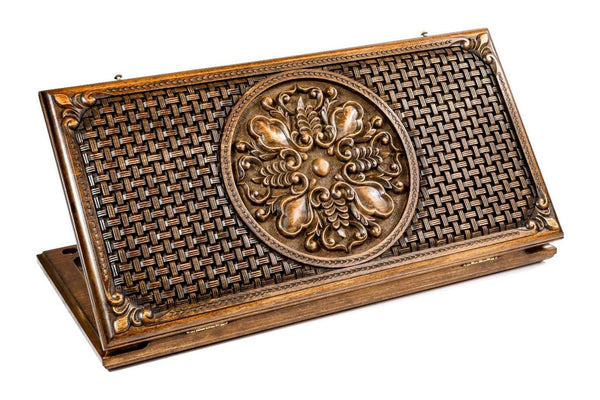
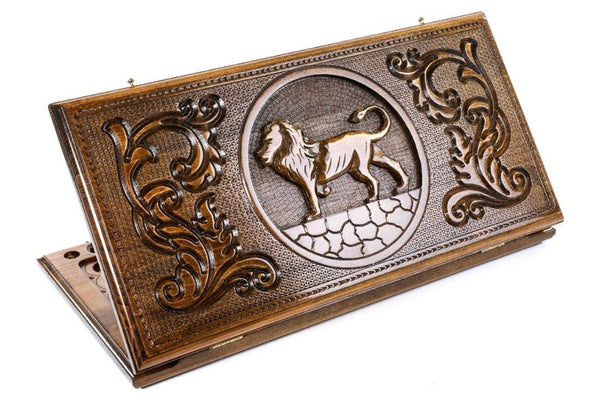
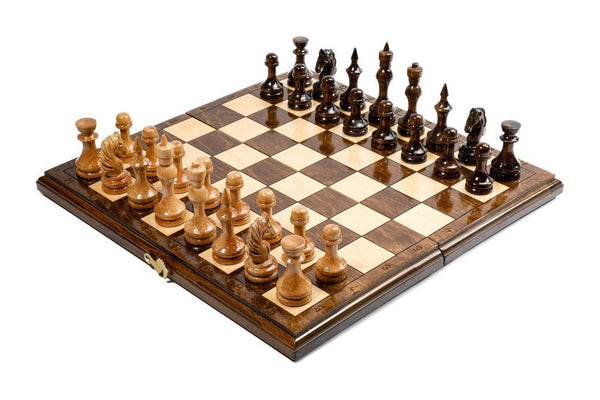
Long and short nardi are played on the same board, with 15 checkers per player and two dice, so any backgammon set will do. A classic 60 cm board is the easiest to read while you learn, and 30 or 40 cm boards are handy for travel; our board size guide compares them. Browse our handmade backgammon sets and large boards, or choose one of our personalised backgammon sets as a gift: we do free laser engraving of a name, date or short wish of up to 80 characters on the same day.
Frequently asked questions
How long does it take to learn long nardi?
One evening is usually enough to learn the rules. Confidence comes with practice: after a few dozen games most players no longer need to check the rules.
How long does a game of long nardi take?
Usually from 30 minutes to an hour, depending on the players' experience.
What is the difference between long and short nardi?
In long nardi all checkers start on the head, both players move in the same direction and there is no hitting. In short nardi, which is classic backgammon, the checkers start spread across the board, the players move towards each other and a single checker can be hit. Read more in long nardy vs short nardy.
Can I play long nardi on a backgammon board?
Yes. It is the same board with the same 15 checkers per player and two dice; only the starting position and the rules are different.
Can three people play nardi?
Yes, on a special three-player board. Here is how to play backgammon with three people.