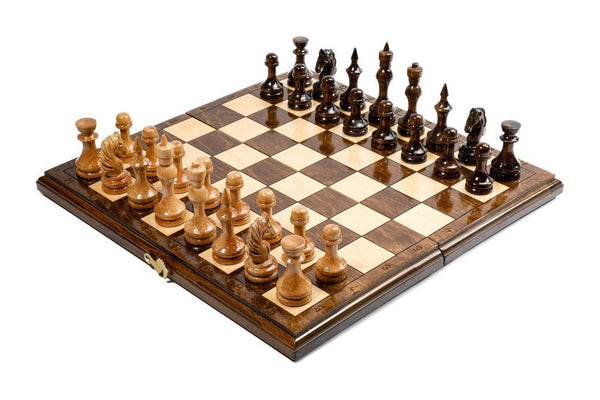
In Armenia, Georgia, Azerbaijan, Russia and much of the region, a wooden nardi board on the table rarely means just one game. Players switch between long nardy and short nardy — the game most of the world simply calls backgammon. Both use the same board, 15 checkers per player and two dice, yet they feel completely different. Here is a clear guide to the differences.
Short nardy (backgammon) in brief
Short nardy is classic backgammon. The checkers start spread across the board in the standard 2-5-3-5 setup, the two players move in opposite directions, and the game is full of contact: a single checker on a point (a “blot”) can be hit and sent back to the bar. If you are new to it, start with our backgammon rules for beginners.
Long nardy in brief
Long nardy is the traditional game of the Caucasus and the former Soviet countries and descends from the ancient Persian game of nard. Each player stacks all 15 checkers on a single starting point called the head, and both players move in the same direction (anticlockwise) around the board. There is no hitting at all — the game is about racing, blocking and timing.
The key differences
| Short nardy (backgammon) | Long nardy | |
|---|---|---|
| Starting position | Checkers spread over four points | All 15 checkers on the “head” |
| Direction | Players move in opposite directions | Both players move anticlockwise |
| Hitting | Yes — blots are sent to the bar | No — you may not land on any point the opponent holds |
| Point control | Two or more checkers make a point | A single checker already blocks the point |
| Special rules | Bar, entering from the bar, optional doubling cube | Head rule and six-point blocking rule |
| Character | Tactical and aggressive | Strategic and positional |
The head rule
In long nardy you may take only one checker off the head per turn. The traditional exception is the very first roll of the game: with certain doubles (such as 6-6, 4-4 or 3-3) a second checker may leave the head, because otherwise the move could not be played. The head rule forces both players to develop their checkers patiently.
Blocks and the six-point rule
Because one checker is enough to hold a point, long nardy is a game of walls. You can build a block of consecutive points to slow your opponent down, but you may not build a solid row of six points that traps all of the opponent’s checkers — at least one of their checkers must already be ahead of the block.
Doubles and bearing off
In both games a double is played four times: roll 4-4 and you move four times four. Once all of your checkers reach your home quarter, you start bearing them off. In long nardy a win where the opponent has borne off at least one checker is called oyn (1 point); if they have borne off none, it is mars (2 points).
Which game should you play?
- Choose short nardy if you enjoy quick tactics, risk and comebacks.
- Choose long nardy if you prefer calm planning, blocking and reading the whole board.
The good news: you do not have to choose a board. Every handmade backgammon set from our workshop works for both games, and many come with 32 checkers and a reverse side laid out for checkers (draughts). For a board with a story, see our Mount Ararat backgammon sets.