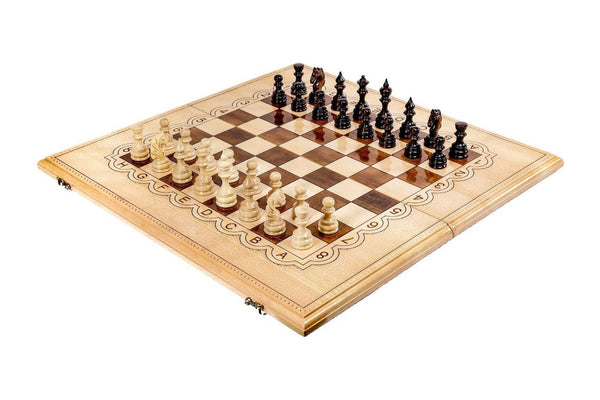
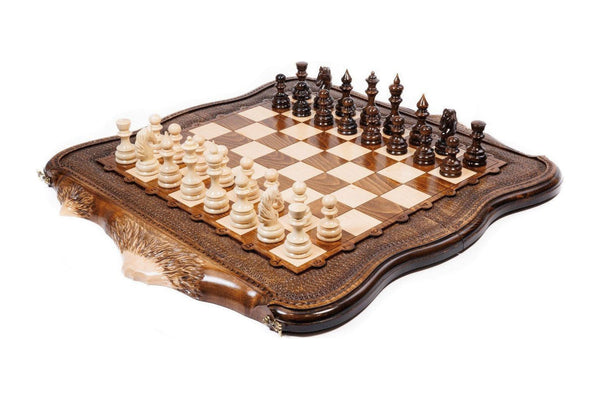
In short: decide how you will use the set, then check four things: square size (the world chess federation, FIDE, specifies 5–6 cm), Staunton-style pieces with stable, padded bases, a wood and finish you like, and a format that suits your space.
A chess set is something you will handle for years. This guide explains how board size relates to piece size, what to look for in the pieces, how walnut and beech differ and which formats exist.
Start with how you will use the set
A set for nightly games at the kitchen table differs from one for travel or a living-room shelf. Which describes you?
- Learning or regular play: easy-to-read squares, clear contrast between light and dark, and pieces that are easy to tell apart.
- Travel or little space: a lighter board that closes with locks.
- Display: carving, wood and finish matter most, and a larger board shows them off.
- Gift: a design with personal or cultural meaning, ideally with an engraved dedication.
How big should the board be?
For regular play, aim for squares of 5–6 cm, the size FIDE specifies in its equipment regulations. Eight squares sit across the board and a frame surrounds them, so in our range that points to boards of about 50–60 cm.
Squares and pieces must suit each other. FIDE requires four pawns to fit comfortably on one square, and a common rule of thumb says a king's base should cover 75–80% of a square's width. FIDE's standard king stands about 9.5 cm tall, with a base 40–50% of that height.
Squares are always a little smaller than one-eighth of the listed board size, because of the frame:
- 30 cm (about 1.5 kg): squares under 3.75 cm. Compact, for travel, a desk or a first set.
- 40 cm (about 3 kg): squares under 5 cm. A sensible choice when table space is limited.
- 50–60 cm (about 4–5 kg): squares can reach the 5–6 cm range, the all-round size for regular play.
- 70–100 cm: statement boards, best shown on a table of their own.
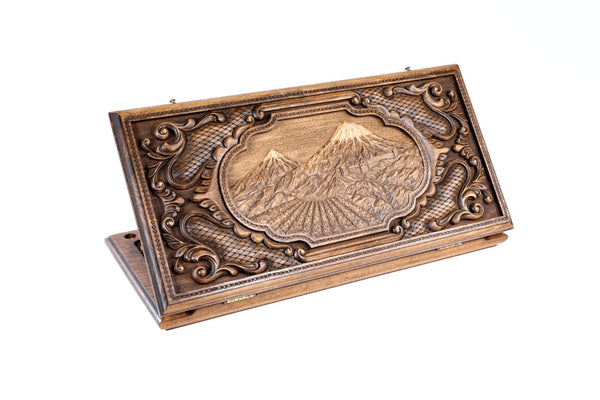
Our Mount Ararat Chess Set, 50 cm, carved from one piece of beech, belongs to that all-round group.

What should you look for in the pieces?
Look for Staunton-style pieces. The pattern was registered in March 1849 by Nathaniel Cooke and went on sale that year. It carries the name of Howard Staunton, the leading player of the 1840s, who endorsed it but did not design it. Each piece has its own silhouette: a cross on the king, a coronet on the queen, a notched mitre on the bishop, a horse's head on the knight. It has been the tournament standard since the 1920s, and FIDE's regulations still ask for it.
Whatever the style, check three things:
- Distinct tops: FIDE wants every piece recognisable from about two metres, with the king's top clearly unlike the queen's and the bishop's unlike the pawn's.
- Weight and a soft underside: FIDE asks for pieces with a suitable weight for comfortable moving, stable enough to survive a tilt of about 30 degrees, with felt pads or similar material underneath. Our 32 pieces, in beech and walnut, have velvet fabric on the bottom of each piece.
- A fit for the board: test the 75–80% rule when buying separately. Our chess pieces and figures range from classic wooden sets to sculptural bronze figures; classic shapes read faster in play, sculptural ones shine on display.
Which wood and finish suit you?
Choose walnut for a dark, formal look and beech for a lighter one. Both are hardwoods, and FIDE's regulations name both among the natural woods suited to boards. Walnut runs from pale brown to deep chocolate. Beech is pale, hard and fine-grained, a wood used for flooring and furniture, so it copes well with daily play. Our walnut vs. beech comparison has more detail. Our boards are varnished, and some combine wood with coloured epoxy resin.
Which format fits your space?
The classic choice is a folding board: on many of our models it closes on cast bronze hinges and locks, and the pieces travel in a branded carry case.
A box-style set adds storage: it stands on carved legs and its top opens to hold the pieces, as on our Box-Style Chess Set with Storage, 70 cm.

Other formats include:
- Chess table: 60 × 60 × 63 cm, with drawers for the pieces. See our chess tables.
- 2-in-1 set: chess on one side, backgammon on the other. Browse the chess and backgammon sets.
- Three-player chess: a separate game on a three-sided board, not a substitute for a standard board.
Small details that make a set last
Coordinates. Letters a–h and numbers 1–8 around the frame let you find a square such as e4 when following a book or a game on screen. FIDE recognises only this algebraic notation. Ours are cast bronze or carved.
Craftsmanship. On a handmade board, look for clean joints, even squares, smooth edges and carving with real depth. On many of ours the whole playing field is carved from one piece of wood, and product pages state a 25-year guarantee certificate.
Engraving and care. On our personalised chess sets we engrave a name, date or short wish of up to 80 characters inside the board, free of charge. Wood responds to light, heat and humidity, so keep our care guide to hand.
Quick decision guide
| If you… | Look for… |
|---|---|
| play often or are learning | a 50–60 cm board with letters and numbers, Staunton-style pieces and padded bases |
| travel or have little space | a 30 cm folding board that locks shut |
| want a showpiece | a carved walnut or Mount Ararat board, or a box-style set |
| want a set that is always ready | a chess table with drawers |
| also enjoy backgammon | a 2-in-1 chess and backgammon set |
| are choosing a gift | a board with an engraved name, date or short wish |
Frequently asked questions
What size chess set is best for adults?
Aim for squares of 5–6 cm, the range FIDE specifies, which means a 50 or 60 cm board in our range. A 40 cm board suits a smaller table, a 30 cm folding set suits travel, and 70–100 cm boards are mainly for display.
What is the best wood for a chess set?
No single wood is best. Walnut is darker, from pale brown to deep chocolate, and looks formal; beech is pale with a fine, even grain. Both are hardwoods, and FIDE's regulations name both for boards. Pick the look that suits the room.
What is a Staunton chess set?
A Staunton set uses the piece design registered in 1849 and named after Howard Staunton, who endorsed it. Every piece has a distinct silhouette and a wide base, so pieces are easy to tell apart and hard to knock over. FIDE's regulations ask for this style.
Is a folding chess board good for tournaments?
For home, club and casual play, yes. Official events set their own rules: FIDE's regulations call for rigid, perfectly flat boards with 5–6 cm squares, a matt finish and clear contrast. A hinged board may not qualify, so check the event's rules.
How do I choose a chess set as a gift?
Match the set to the player: a regular player will enjoy a 50–60 cm board, while a collector may prefer a larger carved set or a table. Add an engraved name, date or short wish. Our gift ideas for chess players cover every level.
Explore our chess sets
Browse our handmade chess sets, or look at the Mount Ararat chess sets if you want a design with a story. If you are unsure between two sizes, contact us for advice.